

Building an AI-Powered Mobile App with Ruby on Rails and DigitalOcean

Inside CoChefy’s Architecture
Building an AI-powered consumer app today comes with a lot of noise.
New frameworks, new models, new infrastructure patterns — all promising speed, scale, and intelligence out of the box.
When we started building CoChefy, our goal was much simpler: Ship a real product, iterate quickly, and stay in control of complexity.
That mindset shaped every architectural decision we made.
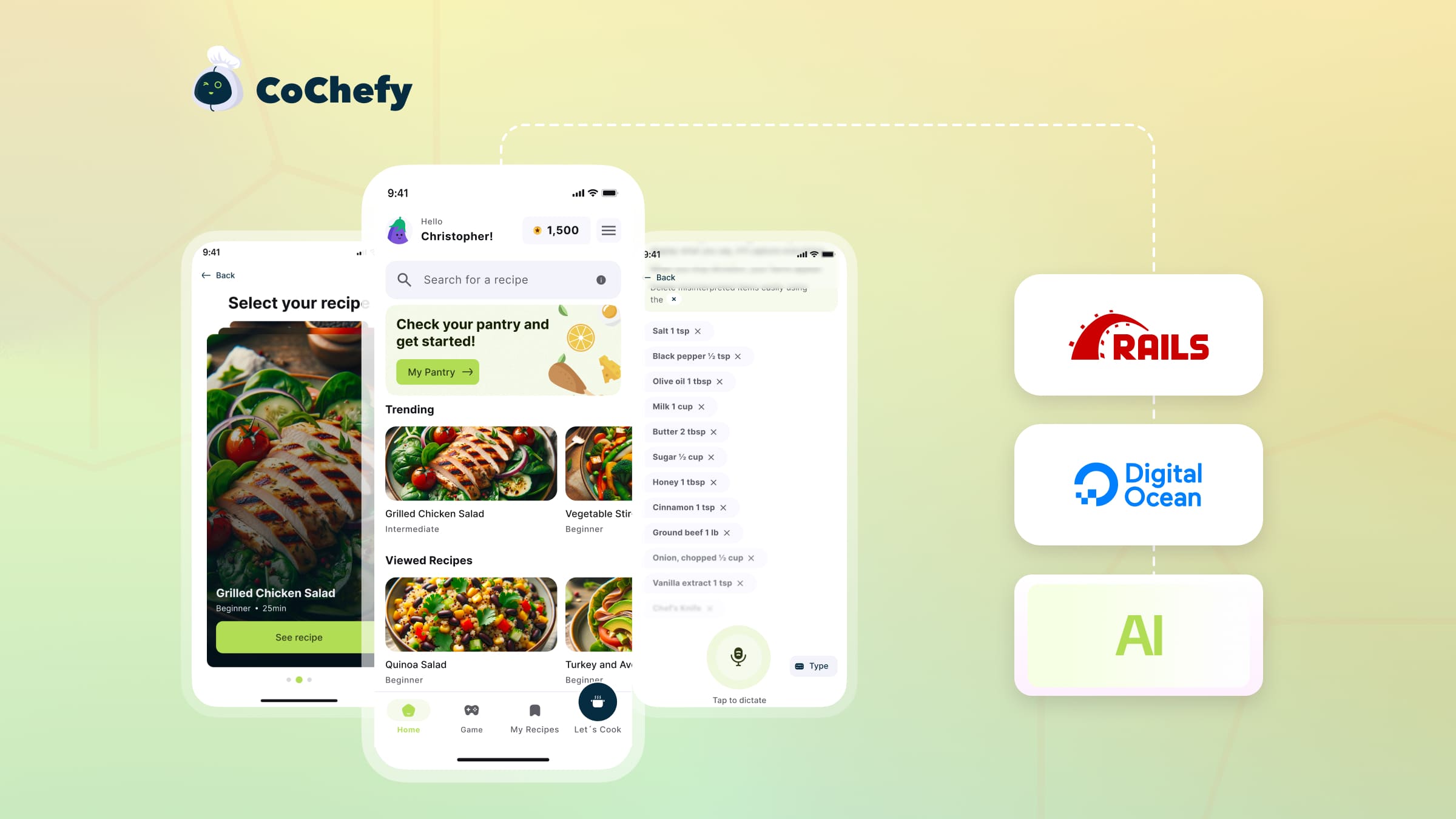
This article shares a high-level look at how CoChefy is built using Ruby on Rails and DigitalOcean, and why a pragmatic, Rails-first approach made sense for an AI-assisted mobile app.
Why This Stack, and Why It Matters
CoChefy is a consumer product.
That means it has to be:
- Reliable
- Predictable
- Easy to evolve
- Cost-conscious in its early stages
AI plays an important role in the experience, but it is not the product by itself. Users don’t open CoChefy “to use AI” — they open it to decide what to cook, reduce food waste, and make daily cooking easier.
From day one, we optimized for:
- Fast iteration over theoretical scalability
- Clear domain logic over experimental architecture
- Technology that reduces risk instead of introducing it
That immediately ruled out building around AI as the core system.
Ruby on Rails as the Product Backbone
At the center of CoChefy is a Ruby on Rails application acting as the single source of truth.
Rails handles:
- Users and accounts
- Pantry data and ingredients
- Recipes and generated content
- Game mechanics and daily challenges
- Permissions, validation, and persistence
This is not accidental.
Rails gives us:
- Strong conventions that reduce decision fatigue
- A clear, opinionated structure that scales with the team
- Mature patterns for APIs, background work, and data modeling
Most importantly, Rails allows us to treat AI as a capability, not a foundation.
The product logic remains deterministic, inspectable, and testable.
High-Level System Architecture
At a conceptual level, CoChefy’s architecture looks like this:
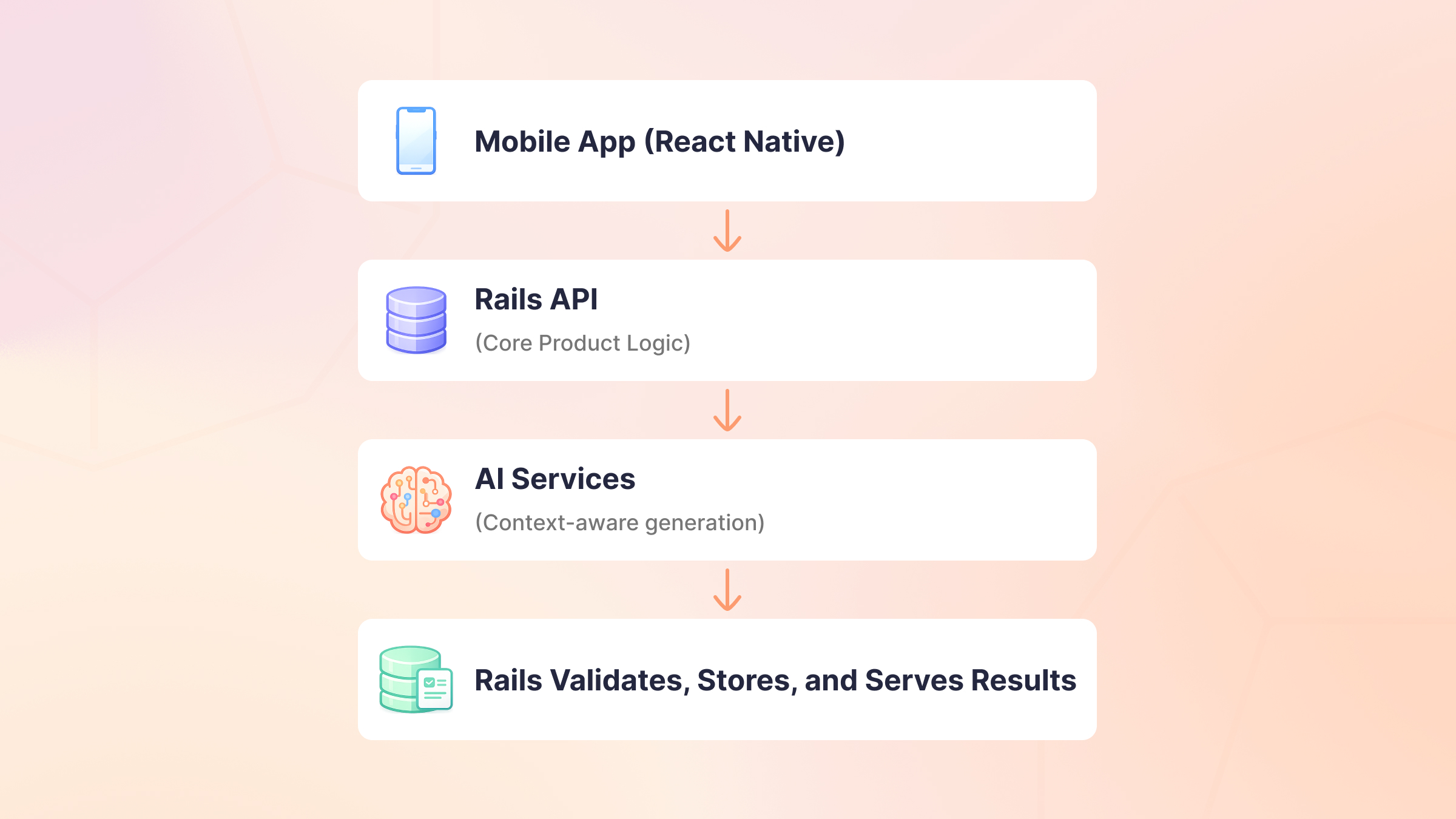
A few key principles guided this structure:
- The mobile app is intentionally thin
- Rails owns business rules and state
- AI services are invoked where they add value
- Generated output is treated as input, not truth
This separation keeps responsibilities clear and prevents the system from becoming fragile or opaque.
AI enhances decisions — it doesn’t make them blindly.
AI as a Supporting Capability
In CoChefy, AI exists to improve the experience, not to drive the architecture.
We designed the system so that:
- AI operates within clearly defined boundaries
- Context is curated before requests are made
- Results flow back through traditional validation and storage layers
This allows us to:
- Maintain predictable behavior
- Evolve prompts and models without destabilizing the product
- Keep the user experience consistent
From an architectural perspective, this is intentional restraint.
AI is powerful, but products still need structure.
Infrastructure Choices: Pragmatic by Design
When you’re building a product that you know won’t generate revenue immediately, infrastructure choices matter more than people like to admit.
In that context, DigitalOcean made sense.
Not because it’s exotic or cutting-edge — but because it’s practical.
DigitalOcean gives us:
- The core infrastructure capabilities we need
- A simpler operational model
- Predictable costs at an early stage
For products like CoChefy, you can get nearly everything you need from modern cloud infrastructure without paying a premium for scale you don’t yet require.
This is not about cutting corners. It’s about aligning costs with reality.
As the product grows, infrastructure can evolve — but early decisions should support momentum, not slow it down.
What This Approach Enabled
This architecture allowed us to:
- Iterate quickly without fear
- Keep the system understandable as it grew
- Onboard contributors with minimal friction
- Focus on product decisions instead of infrastructure debates
Most importantly, it kept the team’s attention where it belonged: On users, not plumbing.
Building Real Products, Not Demos
CoChefy is proof that:
- Ruby on Rails remains a strong foundation for modern products
- AI doesn’t need to dominate your architecture to deliver value
- Pragmatic engineering choices compound over time
This approach isn’t unique to CoChefy.
It reflects how we think about building products at 10 Grounds — with clarity, restraint, and long-term maintainability in mind.
Technology should serve the product.
Not the other way around.
Building CoChefy — Blog Series
This article is part of our ongoing “Building CoChefy” series, where we share how we designed, built, and launched an AI-powered cooking app from idea to production.
So far in the series:
1. From Idea to MVP: How We Designed CoChefy
How we used design sprints, validation, and prototyping to turn a real-world problem into a product foundation.
2. Launching Our First App: CoChefy Is Live
A behind-the-scenes look at launching our own product after years of building apps for clients.
3. Feature Focus: Turning Your Pantry into a Recipe Generator
How we designed around what users already have, and how AI helps transform simple inputs into usable recipes.
4. Feature Focus: The Daily Cooking Game
Why we added gamification, how the daily word game supports habit-building, and what we learned about retention.
5. Building an AI-Powered App with Ruby on Rails and DigitalOcean (you’re here)
A high-level look at the architecture and engineering decisions behind CoChefy.
Each post focuses on a different layer of the product — from design and UX to infrastructure and AI — and together they tell the full story.
- Building an AI-Powered App with Ruby on Rails and DigitalOcean (you’re here)
A high-level look at the architecture and engineering decisions behind CoChefy.
Each post focuses on a different layer of the product — from design and UX to infrastructure and AI — and together they tell the full story.